Kuala Lumpur Was Just the Beginning: A Kenyan Survivor's Route Through Southeast Asia's Scam Compounds


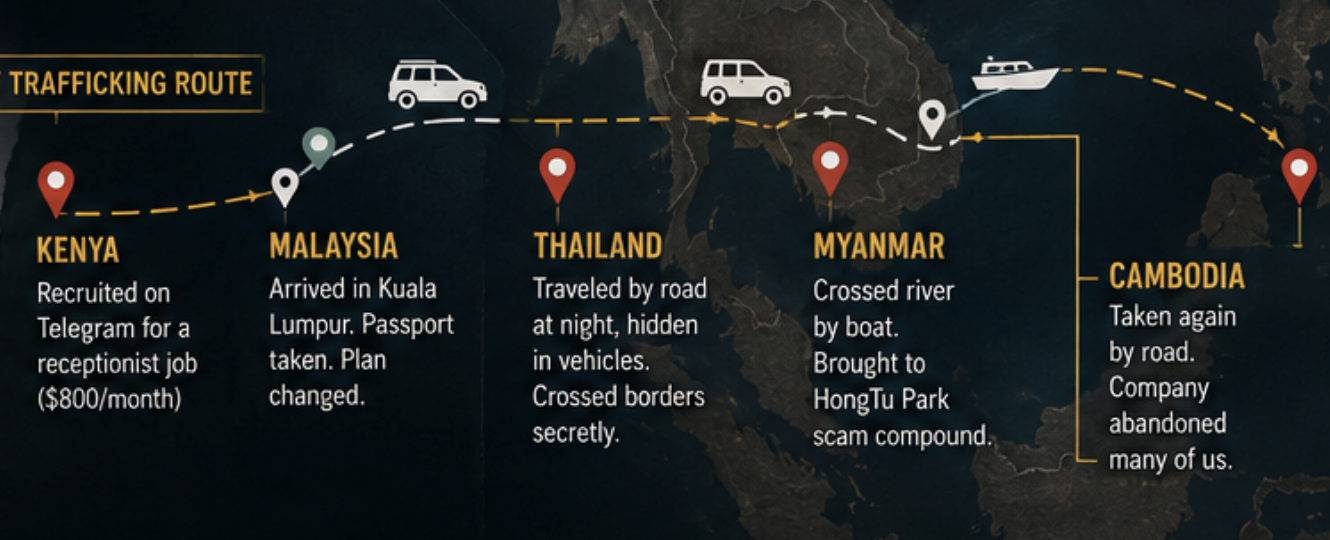
My name is Evans, a Kenyan survivor of human trafficking escaping from scam operations in Southeast Asia. I want to share my story and the difficult situation I have been through.
In November 2025, someone contacted me through Telegram about a receptionist job opportunity in Cambodia. At the time, I saw it as a chance to change my life and improve my family's situation back home. Coming from a poor background in Kenya, such opportunities are rare, and I believed this could be the breakthrough I had been hoping for. The agreed salary was $800 per month.
Before reaching Cambodia, I was first taken through Malaysia in a way that made everything seem legitimate. The recruiters explained that Malaysia was the cheapest transit route, as there are no direct flights from Kenya to Cambodia, and that Malaysian visas are not required for Kenyan citizens.
While still in Kenya, I was issued what appeared to be a valid visit visa, which gave me confidence that the process was genuine. At Jomo Kenyatta International Airport, we were even given "show money" to present if questioned by immigration officers, both in Nairobi and Kuala Lumpur, so that we would appear to be normal travellers. I travelled alone from Kenya, but when I arrived in Malaysia I met seven other Kenyans who had been recruited the same way.
The Trafficking Journey from Malaysia to Thailand
When we arrived in Malaysia, everything still felt convincing. We were warmly received, given food, and accommodated in a fancy hotel. At that point, there was little reason to doubt anything. Our passports were then collected, supposedly to process our work visas.
The next day, things began to change. Instead of preparing for a flight to Cambodia as expected, we were told there had been a change of plans. We were taken into private vehicles and informed that we would continue the journey by road. This immediately raised suspicion, and we began asking questions. Instead of answers, we were met with threats. We were told we had to follow instructions because we were now considered to be there illegally. If we refused, we would be abandoned and never see our families again. That is when I realized the job was not what I had been promised. It was one of the most terrifying moments of my life, and I did not yet understand it was only the beginning.
Throughout the journey, we had no internet access and were transported mostly at night in tinted vehicles, which made it impossible to identify our locations or the routes we were taking. At each border crossing, we were handed over to local people who guided us across.
We drove for about eight hours across Malaysia without knowing our destination. Around 8 p.m., we arrived at what looked like an abandoned place, a kind of safe house, where we were given food and locked in.
At around 3 a.m. the next morning, we were woken by loud banging on the doors and shouting in broken English. We were forced back into vehicles, which appeared to be travelling with escort cars, possibly to avoid police checkpoints. Eventually, we reached a dark, remote area surrounded by thick bush. It was completely silent, far from any sign of civilization. I could hear a river nearby.
We were led to the riverbank and forced onto small motorboats that were overcrowded with people and luggage. We were ordered to lie down and covered with a thick cloth so we could not see anything. It was terrifying. There was nothing we could do except pray. After about thirty minutes on rough water, we reached the other side. That is when I heard one of the men say, "Welcome to Thailand."
From there, we were quickly moved into waiting vehicles and driven for about an hour to another safe house. We were given food, and instructions were communicated through Google Translate. We had no internet access and no way to contact our families. That night, none of us could sleep.
Crossing the Border from Thailand into Myanmar
At dawn, we continued the journey, driving almost the entire day through Thailand. We eventually arrived in Tak, where we were again given food and a place to stay under strict control. The following day, we were taken to Mae Sot, where we spent another night in a private house.
Soon after, we crossed another river by boat and entered Myanmar. The compound we were brought to was HongTu Park, located just a few miles from the river that borders Thailand and Myanmar — visible from the riverbank itself. Upon arrival, we underwent medical tests — HIV and other STIs, and for the women, pregnancy tests as well — and our personal phones were taken and reset to erase any traceable information. It was there that the reality of the situation became clear. We were given rules and forced to sign contracts written in Chinese, documents we could not understand.
The salary arrangement we had been promised quickly proved to be a fiction. The company imposed a system of fines tied to a strict set of rules — rules that were clearly designed so that most workers would end up with nothing at the end of each month. In the entire time I was there, I was paid only once, in cash, and not in full: 5,000 Thai baht, roughly $155.
Transfer from Myanmar to Cambodia During Regional Crackdowns
After a few weeks of working under pressure using scripts provided to us, I realized I had been lured into a Chinese-run crypto scam operation. We were running dating scams, targeting victims primarily in the United States. By then, I was far from home and trapped in a situation I had never intended to be part of. When the Myanmar government began cracking down on scam operations, we were smuggled out again using similar methods and eventually taken to Cambodia.
Life inside the compound was tightly controlled. Communication and daily operations were managed through Telegram channels, where supervisors shared scripts, targets, and instructions. We were not allowed to bring personal phones into the office and instead used company phones that had to remain there. Occasionally, we could access our personal phones, but only briefly and under strict conditions. What was happening inside the compound was not hidden. Everything was so organised and open that it was difficult to believe law enforcement was unaware of it.
Surviving Abandonment and Hardship in Cambodia
Things worsened when the Cambodian government also began cracking down on crypto scam operations. The company that had brought us there abandoned many of us, leaving us without support, jobs, or a clear way to return home.
After that, I stayed in a small hotel, trying to survive day by day. Paying for the room and finding food became a constant struggle, and I eventually ran out of money. Some days I ate only once, while other days I went without food entirely.
This situation took a serious toll on my mental health. I felt overwhelmed and deeply depressed. My parents tried to support me by sending small amounts when they could, but it became very difficult for them, as they were already struggling financially.
I sought help from the Kenyan embassy and humanitarian organizations. Although there was an amnesty program, it required individuals to pay for their own flight tickets, which I could not afford. In desperation, I shared my story through a Kenyan media platform. By good fortune, a kind well-wisher came across it and generously paid for my flight home. With the support of the embassy, I was able to return safely to Kenya.
I am now back home and working to rebuild my life after this traumatic experience. I am seeking support, guidance, and opportunities to reintegrate and move forward. I also hope to raise awareness so that others do not fall victim to similar schemes.
Contact Evans
Evans has chosen to share his contact information in this article and welcomes direct outreach from anyone who may be able to support his reintegration or help him identify employment opportunities.
WhatsApp: +254 759 973713
Email: evanxkyalo.com@gmail.com