The Scam Compounds Brief Special Issue: Mapping the Global Expansion of Chinese-speaking Scam Syndicates, 2010–2026


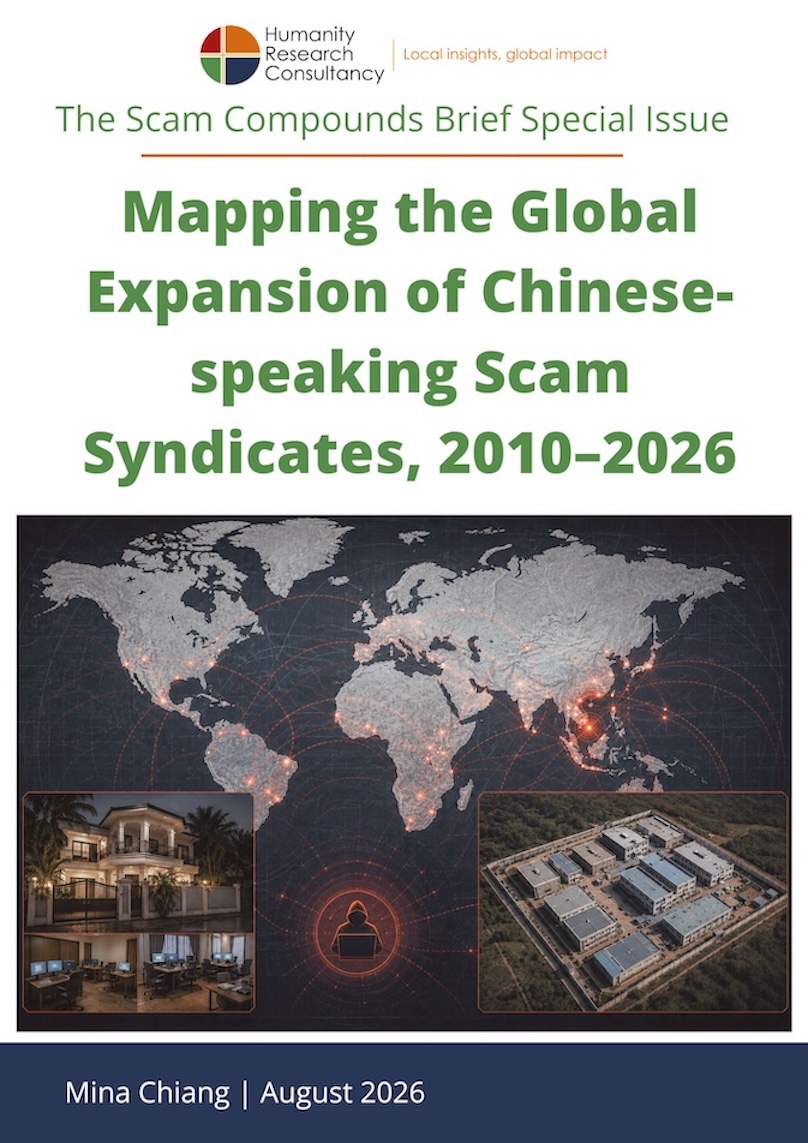
As law enforcement pressure on scam compounds has intensified across Southeast Asia, increasing attention has been paid to reports of scam operations emerging in new regions. Much of the recent discussion has described this trend as the start of expansion of scam compounds beyond Southeast Asia. While this reflects genuine concerns about the international spread of these criminal networks, such characterisation risks oversimplifying both their history and their organisational evolution.
By documenting historical and contemporary cases from 2010 to 2026, this report provides a chronological overview of the global footprint of Chinese-speaking scam syndicates and offers a framework for understanding both the continuity and transformation of their overseas operations.
This report seeks to make three contributions.
First, it demonstrates that the overseas expansion of Chinese-speaking scam operations is not a new phenomenon. By 2017, the Chinese government claimed that scam operations of various sizes, established by Taiwanese and Chinese nationals, had been identified in at least 40 countries, primarily targeting Chinese-speaking victims.
Second, this report argues that describing recent developments simply as the expansion of scam compounds can be misleading. Although Chinese-speaking scam syndicates are increasingly exploring new jurisdictions, most documented overseas operations follow an “outpost scam model” orchestrated by a single leadership team, rather than the multi-tenant landlord–tenant industrial park model characteristic of scam compounds. This distinction is important because the two models are enabled by fundamentally different operational logics.
Third, the historical cases documented in this report point to two possible explanations that deserve further research. Several countries hosted Chinese-speaking scam operations before the COVID-19 pandemic but have no publicly reported cases after 2020. One explanation is that criminal groups have tested different jurisdictions over time and moved away from countries with stronger law enforcement responses. Another is that scam operations continue to exist in some countries but remain undetected because of limited local enforcement, reporting, or public disclosure.
